Lent at St. Mary’s
Lent does not begin with a checklist. It begins with an interruption.
On Ash Wednesday, through the prophet Joel, the Lord speaks plainly: Return to me with your whole heart. Not because your classes, internships, friendships, and responsibilities do not matter. They do. But they are not first.
Lent reminds us of something we would rather ignore: Remember that you are dust, and to dust you shall return. Every one of us will die. We do not know when. That truth is not meant to frighten us. It is meant to wake us.
This day is a gift.
Your next breath is a gift.
Your friendships, your opportunities, your very existence is a gift.
Where we run into trouble is not that life is bad. It is that we begin to grasp at the things of this world as if they could save us. We hold onto what no longer leads us to God. We chase what was never meant to satisfy us.
The deepest longings of your heart, happiness, meaning, fulfillment, cannot be found in a lasting way outside of Him. Not because you have not tried hard enough, but because it is impossible.
Lent is not about trying harder. It is about returning. It is about stepping aside so God can do what only He can do.
Lent is an invitation to repentance and renewal. Through prayer, fasting, and almsgiving, we learn again how to draw near to God and allow Him to draw near to us. We walk with Christ toward His Passion, His Cross, and His Resurrection. This is not a private project. It is the Church moving together toward Easter.
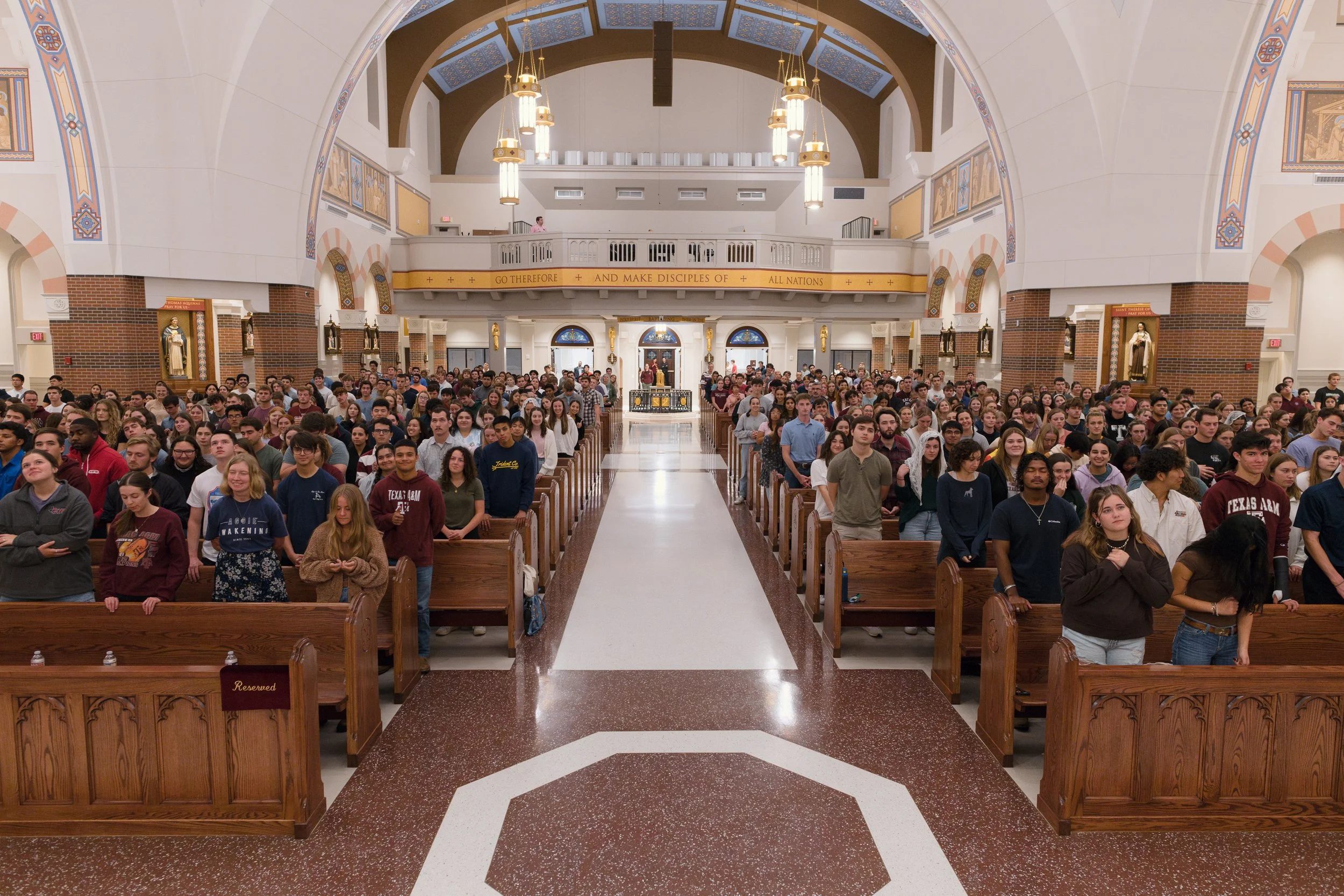
You are not meant to walk this season alone. At St. Mary’s, we return to Him together. In the Word. In the Eucharist. In Confession. In real friendship rooted in Christ.
Make room for Him.
Remain close to Him.
Let Him do what only He can do.
If today you hear his voice, harden not your hearts.
—Psalm 95:8
Join a Lenten Bible Study
Maybe you’ve been wanting to take your faith more seriously but are not sure what that looks like. A Lenten Bible study is a simple place to begin. Learn how to meet Jesus in Scripture each week of Lent. Come on your own or bring a friend. Fill out the form here and a member of our team will reach out to you with more information.
Weekly at St. Mary’s
Monday – Saturday:
4:00 PM – 5:00 PM
Confessions
Monday - Thursday:
8:00 AM – 10:00 PM
Friday:
8:00 AM – 12:00 PM
Eucharistic Adoration
Monday - Friday:
5:30 PM
Wednesday–Friday:
12:00 PM*
*12 PM Mass on Thursday is on campus at All Faiths Chapel
Daily Mass
Stations of the Cross
Fridays
6:15 PM in the Church
During Lent, we seek Jesus in prayer; we serve by giving alms; and we practice self-control through fasting.
Here are a few ideas for growth in those areas as well as a few commonly asked questions:
-
Wake up 20 minutes early and start the day in prayer.
Daily Mass 1-2 times a week.
An hour in Adoration a week.
Go to Confession.
Read Scripture daily.
Read a spiritual book.
Start to pray a daily Rosary.
Pray the Liturgy of the hours.
Stations of the Cross on Fridays.
Pray a Divine Mercy Chaplet.
Pray for your enemies.
Do an extra spiritual activity at Church
Memorize Scripture verses.
-
Start tithing.
Make a pledge to a worthy charity.
When you fast from a meal, give the money you would spend to the poor.
Volunteer with St. Vincent de Paul or another charitable organization.
Visit a nursing home.
Forgive an old grudge.
Invite someone to Church.
Share your faith with someone.
Exercise patience and love.
Speak in a pleasant tone to everyone.
Go out of your way to talk to someone who is shy or difficult.
-
Fast on bread and water on Fridays.
Fast from TV or streaming content.
Fast from snacking or candy.
Fast from music in your car.
Fast from caffeine.
Fast from alcohol.
Fast from Instagram, TikTok, and/or the internet.
Fast from speeding.
Fast from sarcasm or gossip.
Fast from complaining.
Fast from being lazy or procrastinating.
Fast from envying what others have.
-
Catholics are not required to give something up for Lent. We are invited into repentance. Lent is a season to look honestly at what pulls our hearts away from God and to return.
The Lord says through the prophet Joel, Return to me with your whole heart, with fasting, weeping, and mourning. Rend your hearts, not your garments (Joel 2:12–13). Lent is not about surface changes. It is about the heart.
Sometimes that means naming a vice, a habit, or a pattern of sin and bringing it to the Lord. What we surrender in repentance is not meant to be picked back up. Lent is about real conversion.
Other times, we freely give up something good. A comfort. A convenience. A pleasure. Not because it is bad, but because we want to remember that even good things are not God. Jesus says, Whoever wishes to come after me must deny himself, take up his cross, and follow me (Matthew 16:24). Self-denial trains the heart to rely on Him.
This kind of discipline is not about proving strength. Saint Paul reminds us that every athlete trains with purpose, not for a fading prize, but for one that lasts (1 Corinthians 9:25–27). Lent strengthens our desire for what is eternal.
And when we feel weak, distracted, or inconsistent, we do not panic. The Lord says, My grace is sufficient for you, for power is made perfect in weakness (2 Corinthians 12:9). Lent teaches us that dependence is not failure. It is the beginning of trust.
Giving something up only matters if it helps you return to Christ. The goal is not self-control. The goal is communion.
Let this season refine your heart. Let it draw you closer. Let it make space for Him.
-
We fast because Jesus calls us to.
In the Sermon on the Mount, He does not say if you fast. He says, when you fast (Matthew 6:16). Fasting is not about drawing attention to ourselves. It is quiet. Hidden. Done for the Father who sees in secret.
When we deny ourselves something good, we remember what the highest good is. God.
Hunger has a way of telling the truth. It reveals how quickly we reach for comfort, distraction, or control. Fasting brings that to the surface, not to shame us, but to reorient us.
Jesus Himself fasted for forty days in the desert (Matthew 4:2). He entered into weakness and temptation and remained faithful to the Father. When we fast, we walk that same path. We learn to say no to what does not lead to life so that we can say yes more fully to Him.
Fasting also deepens prayer. Scripture tells us, Yet when they were ill, I...humbled myself with fasting. (Psalm 35:13). When the body is disciplined, the heart becomes more attentive. We become more aware of our dependence, more honest about our need.
From the early Church to now, fasting has always been an act of worship. Anna in the temple served the Lord with fasting and prayer night and day (Luke 2:37). Fasting is not self-punishment. It is devotion.
Lent does not ask you to starve yourself. It asks you to hunger rightly.
Let your fasting make you aware of what you truly desire. Let it teach you that Christ is enough. And when you feel your weakness, remember His words: My grace is sufficient for you.
Fasting is not about strength.
It is about surrender. -
On Fridays during Lent, Catholics age 14 and older abstain from meat. On Ash Wednesday and Good Friday, Catholics ages 18 to 60 also fast. These practices are not arbitrary rules. They are part of how the Church teaches us to remember.
Friday is the day Christ gave His life for us.
From the earliest centuries, Christians set aside Friday as a day of penance because it is the day Christ died on the Cross. During Lent, that memory becomes more intentional. Each Friday is a quiet return to Calvary.
Abstaining from meat is a small sacrifice, but it is meant to train the heart. Scripture shows us that God’s people have always practiced restraint in times of repentance. The prophet Daniel writes, I ate no choice food; no meat or wine touched my lips as he sought the Lord (Daniel 10:2–3). Physical restraint helps awaken spiritual desire.
For many of us, meat is not rare. It is normal. Giving it up reminds us that even normal comforts are gifts. It teaches us that we do not live by comfort alone.
Abstinence is not about earning God’s love. It is about remembering Christ’s love.
When we give up something small on Friday, we unite it to His greater sacrifice. We allow our bodies to participate in what our hearts profess. We remember that salvation came through the Cross.
And we do it together.