
Our History
More Than 120 Years of Christ Among the Aggies
The story of St. Mary’s Catholic Center began with six young men willing to walk six miles to attend Mass.
In March 1904, six cadets from the Agricultural and Mechanical College of Texas arrived at St. Joseph Catholic Church in Bryan for Sunday Mass. Their presence caught the attention of the parish’s newly assigned priest, Father John Baptist Gleissner. When he learned how far they had walked, he was deeply moved. “What a source of edification they were to me and the congregation,” he later recalled. “No matter how the weather, they came.”
Their faithfulness revealed both a need and a possibility. Catholic students at A&M needed a place where they could encounter Christ, receive the sacraments, and belong fully to His Church. Father Gleissner began working to bring the Church closer to them.
Born in Bavaria in 1865, John Gleissner had immigrated to the United States as a young man, entered the seminary, and was ordained a priest in Galveston on July 10, 1889. After serving several small parishes in Central Texas, he was assigned to St. Joseph’s in Bryan and its missions in Caldwell and Frenstat. His encounter with those six cadets would shape the rest of his priesthood and begin a mission that continues today.
In April 1904, Bishop Nicholas A. Gallagher of the Diocese of Galveston granted Father Gleissner permission to celebrate Mass for the students at A&M as often as possible. The first Masses were offered in a classroom in the old Civil Engineering Building. With only a crucifix, two candlesticks, and a makeshift altar, Catholic students gathered around the Eucharist.
There was no church building, no student center, and no established campus ministry. There was simply a priest, a group of students, and Jesus Christ present among them.
From that small beginning, St. Mary’s began to take root.
Six Cadets and a Faithful Priest
Monsignor John Baptist Gleissner was born on October 31, 1865, in Bavaria, Germany. He immigrated to the United States as a young man, entered the seminary, and was ordained a priest in Galveston on July 10, 1889.
In March 1904, after serving several small parishes in Central Texas, Father Gleissner was assigned to St. Joseph Catholic Church in Bryan and its missions in Caldwell and Frenstat.
One Sunday, six young men wearing the cadet uniform of the Agricultural and Mechanical College of Texas attended Mass at St. Joseph’s. Father Gleissner learned that they had walked six miles from campus to be there.
“What a source of edification they were to me and the congregation,” he later recalled. “No matter how the weather, they came.”
Their witness moved him. Father Gleissner recognized the importance of bringing the Church closer to the students, and he began working to make Mass more accessible to the Catholic cadets.
The First Mass on Campus
In April 1904, Bishop Nicholas A. Gallagher of the Diocese of Galveston granted Father Gleissner permission to celebrate Mass for the students at A&M College as often as possible.
The first Masses were offered in a classroom in the old Civil Engineering Building. With only a crucifix, two candlesticks, and a makeshift altar, Catholic students gathered around the Eucharist.
There was no church building, student center, or established campus ministry. There was simply a priest, a group of students, and Christ present among them.
From that small beginning, St. Mary’s began to take root.


The First St. Mary’s Chapel
As the number of Catholic students grew, Father Gleissner recognized that a campus classroom could no longer accommodate the community.
In 1923, he appealed to the Texas State Council of the Knights of Columbus for help building a permanent chapel for the Aggies. The Knights embraced the need, and plans were soon developed.
The cornerstone of St. Mary’s Chapel was laid on January 9, 1927, the Feast of the Holy Family. Its inscription read:
“St. Mary’s Chapel, erected by the State Council of the Knights of Columbus of Texas, A.D. 1927.”
By April, Aggie cadets were celebrating Mass in their new chapel. It seated approximately 250 people and included a basement where students could gather for socials, conferences, and other activities.
St. Mary’s was already becoming more than a place students visited on Sundays. It was becoming a spiritual home.
The Catholic population continued to grow, as did participation in Confession and Holy Communion. Vocations to the priesthood began to emerge from the community. In recognition of his tireless ministry, Father Gleissner received the title of Monsignor in 1931.
By 1940, the chapel was already too small. Students and parishioners sometimes stood or knelt on the front steps to participate in Mass and other devotions.
A Parish Centered on Students
Until 1968, St. Mary’s functioned as a mission of St. Joseph Catholic Church in Bryan. That year, it was formally established as a parish, with Father Bernard Mahoney serving as its first full-time pastor.
Texas A&M was changing rapidly. The university admitted women beginning in 1963, made participation in the Corps of Cadets optional in 1965, and experienced tremendous growth in its student population.
St. Mary’s grew with it.
The parish served students, faculty, staff, and families throughout College Station. More Masses were added, student organizations expanded, and the church and student center again began to overflow.
In 1971, more than 2,300 Texas A&M students identified themselves as Catholic. St. Mary’s responded by developing more opportunities specifically for students. The Newman Club was revitalized, social gatherings filled the student center, and new organizations began serving the spiritual and material needs of the community.
Between 1972 and 1978, approximately 3,000 Aggies came to St. Mary’s each year for Mass, formation, friendship, and guidance. With support from the Knights of Columbus, the student center was renovated to provide additional meeting rooms and accommodate the growing ministry.
Whether students came for Mass, a shared meal, a conversation with a priest, or an evening with friends, St. Mary’s offered them a place to be known and invited more deeply into the life of Christ and His Church.
Renewing the Mission to College Students
As College Station continued to grow, St. Mary’s faced the challenge of serving both a rapidly expanding student population and an increasing number of local Catholic families.
In 1982, St. Thomas Aquinas Catholic Church was established on the south side of College Station with a particular mission to serve local families. This allowed St. Mary’s to renew and deepen its primary focus on the students of Texas A&M.
Throughout the following decade, student participation continued to grow. Thousands of Aggie Catholics were using facilities originally designed for only a few hundred cadets. Meetings spilled outdoors, choirs rehearsed alongside student gatherings, and nearly every available room was put to use.
Yet the limitations of the building did not limit the life of the community.
Students prayed together, served together, and took responsibility for inviting their peers into the Church. New ministries emerged, including St. Mary’s Youth Retreat Team, Kappa Theta Beta, student-led Eucharistic Adoration, The Rock praise and worship, Pescadores, Nun Run, and Seminary Sprint.
This culture of student leadership became one of the defining characteristics of St. Mary’s. Students were not simply attending programs. They were being formed as apostles and entrusted with the mission of the Church.
A New Student Center
By the 1990s, the need for a larger student center had become undeniable.
Under the leadership of Father Mike Sis, St. Mary’s began the “Building a Tradition in Faith” campaign. For the first time, the parish reached beyond the local community to invite former students and parents of Aggies to help build the future of Catholic campus ministry.
More than 3,000 benefactors contributed to the $5 million project, joined by significant support from the Texas State Council of the Knights of Columbus and the Mabee Foundation.
The resulting 30,000-square-foot student center included classrooms, an activity center, a courtyard, a chapel, and gathering spaces designed to give students a home away from home.
The new facilities were dedicated on April 25, 1998.
Fruit That Will Last
By the time St. Mary’s celebrated its centennial in 2004, the Catholic Center had become known throughout the country for its vibrant campus ministry, strong student leadership, and growing number of priestly, religious, and lay vocations.
But Texas A&M and Blinn College continued to grow. St. Mary’s was now serving a combined student population of approximately 70,000, including an estimated 17,000 Catholics. Even with seven weekend Masses, the church could no longer hold everyone who came.
In 2013, under the leadership of Father David Konderla, St. Mary’s launched the “Fruit That Will Last” campaign to expand the student center and prepare for the construction of a new church.
The first phase raised $11 million for the St. John Paul II addition, which included a larger event center, a new lobby, four large classrooms, and additional offices. The addition was dedicated on October 22, 2019, the feast of St. John Paul II.
These new spaces gave students more room to gather, receive formation, pray, and build friendships centered on Christ.
A New Church for a New Generation
The vision for a new and larger church had been developing for years. In 2017, under the leadership of Father Brian McMaster, the New Church Campaign formally began.
The church was designed around three guiding values:
Beauty: A sacred space that lifts the heart and mind toward heaven.
Encounter: A church that draws people into an intimate meeting with Jesus Christ.
Tradition: A building rooted in the rich sacramental and architectural heritage of the Catholic Church.
Ground was broken on May 19, 2021.
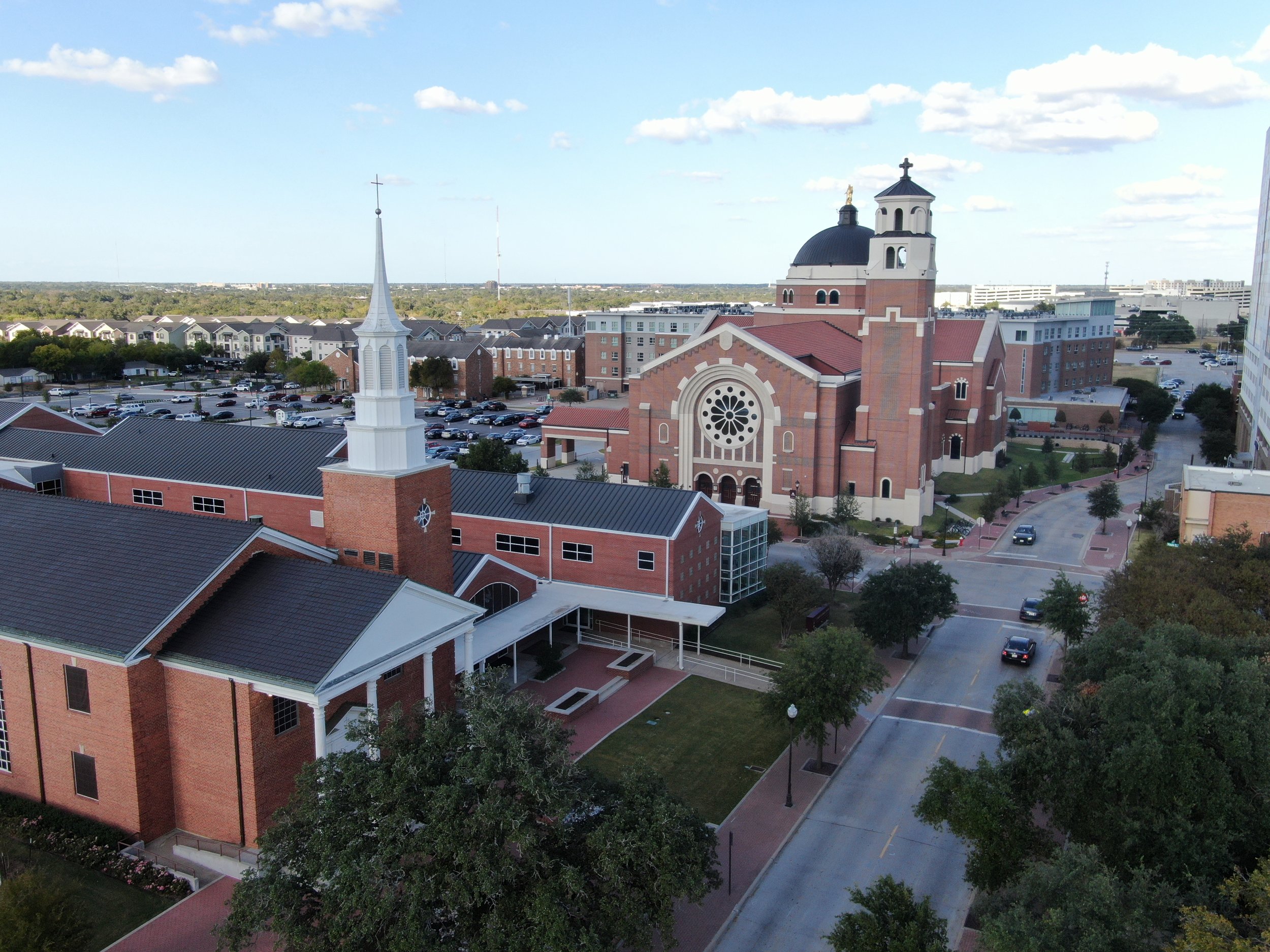
On July 29, 2023, Bishop Joe Vásquez dedicated the new St. Mary’s Catholic Church. With seating for more than 1,500 people, a prominent dome, and a bell tower overlooking Northgate, the church stands as a visible sign of the Catholic faith at the heart of Aggieland.
It was built not simply to accommodate a crowd, but to make room for generations of students to encounter Jesus Christ in the Eucharist and find their home in His Church.


